Well as soon as I read this weeks Illustration Friday prompt "Reversal", my mind (of course) immediately jumped to the concept of Critical Flicker Fusion Frequency.
And I can understand that most people probably thought of the same thing - so if I visit a dozen other blogs and find that most artists have illustrated Critical Flicker Fusion Frequency for their IF topic - then I won't be in the least offended - dissapointed, but not offended.
Of course I, like most people, jumped on the concept of CFFF (the standard abbreviation for Critical Flicker Fusion Frequency) to illustrate "Reversal" because CFFF is one of the adaptations that humans have developed to help us survive in the wild.
More specifically, CFFF not only helps us catch things like rabbits and worms - it stops us being eaten.
But how does it do that? (You see, even though I don't have a spell checker and can't type for chips, I try to end each paragraph with a question to encourage you to keep reading).
To be honest, now we are halfway into this post, I should also admit that CFFF does not only stop you getting eaten - you can also use it as a conversation filler. Just like I am now.
You see, CFFF, like lots of other seemingly boring concepts, has more than one use.
For example: in the middle of your next dinner party when there is one of those embaressing lulls in the conversation where every one suddenly stops talking at the same time, and then stares vacuously into the billowing convection current depths of their Salmon Soup waiting for someone else to take up the metaphorical conversational ball .... well with the concept of Critical Flicker Fusion Frequency firmly under your belt, that person who takes up the ball can be you.
No questions asked.
So it doesn't matter which one of your dinner guests has been discovered having an affair with another dinner guest's wife, daughter, mother-in-law etc, you'll soon have them transfixed with spondules of giggleing joyful gaggling laughter once you introduce them to the miraculous concept of CFFF.
But why is CFFF so interesting, and how, exactly, does it stop you getting eaten?
CFFF is all about the human eye, which is why it's so important for artists, hunters and human beings in general. (Next week I'll give you Mach bands and the concept of temporal and spatial summation to jolly your guests with.)
So if your mind has already started to wander, it's now time to pay attention.
You see, in the human eye there are basically two types of photoreceptors - rods and cones. Though rods are great for vison in low light, you can't see colour with them and they have lower resolution than the cones.
Cones are great for detail. You use the cones of your eye in the centre of your vision so you can read, watch television, or spy on your neighbours' teenage pot smoking children.
On the other hand you use the rods for your periphereal vision.
And that's where CFFF comes in.
Basically Critical Flicker Fusion Frequency is (from Wiki) : "the frequency at which an intermittent light stimulus appears to be completely steady to the observer. Flicker fusion threshold is related to persistence of vision."
So.... have you ever noticed that a flourescent light will flicker in the corner of your eye and drive you nuts? Or the same with old fashioned Televisions?
But when you look at it directly, there is no flicker at all?
Well that's because of the CFFF! How exciting is that eh?
Well, it even gets better.
The reason you see the flicker in the corner of your eye and not in the centre is because the CFFF in your peripheral vision is lower than your central vision. That means you need a higher frame rate (flicker rate) for the light to be seen as non flickering in your peripheral vision.
So although the rods in this area are low resolution, they make up for this by being able to see movement much better than the central of your vision. They will pick up a quick movement in your side vison because of their higher CFFF (or was it their lower CFFF?).
Now isn't that wonderful? Can you picture in your minds eye your otherwise moribund dinner guests wriggling with excitement over their lime sorbets as you regail them with this titbit of data!
But wait. There's more!
So why is a higher peripheral CFFF a handy thing?
Well, basically it means that you can see a small movement out of the corner of your eye.
That means CFFF helps you see small edible animals (worms, rabbits, guinea pigs, dragon flies) when they are not directly in front of you.
But the other thing was with this wonderfully interesting and endlessly fascinating visual phenomena, is that, with CFFF human's can also pick up, in their peripheral vision, the rapid movement of mean things with sharp long teeth - mean things like lions, tigers, wooly mammoths and 'no name' brand monsters.
And that brings us directly to the IF prompt.
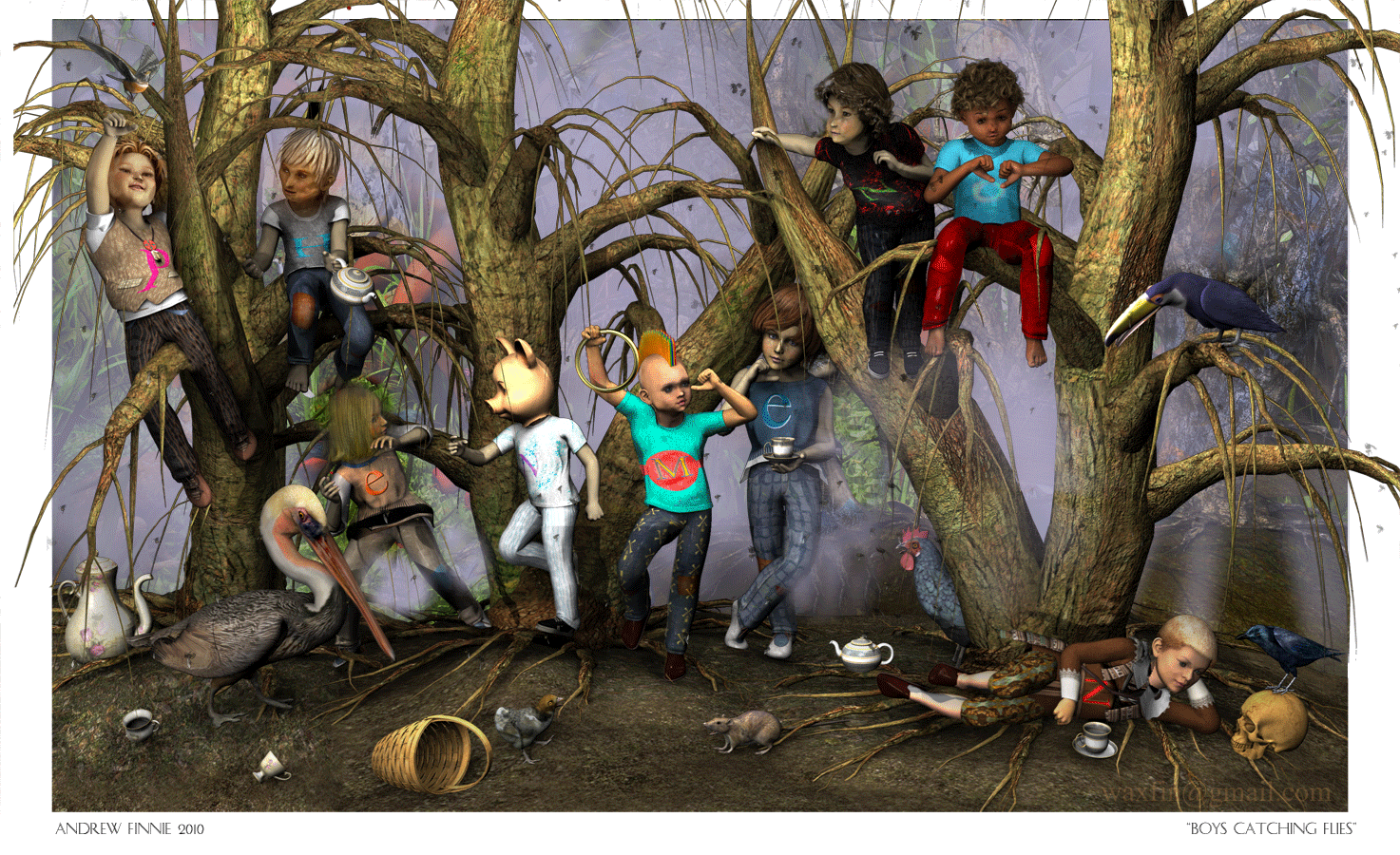
Reversal - in that, in the time you have been reading this post, the hunters in my images, have become the hunted.
Obviously they need to train up their CFFF a little more.
Did you know that Hercules Poirot is on at 8.30 PM Sunday Nights here in Oz?
He'll be on in another twelve minutes.
Which is a bummer.
Because I still had to tell you about the Blue Fairy, how she also fits into this week's theme.
Oh well. Maybe I can work the Blue Fairy in with Mach Bands, and Temporal and Spatial Summation - the subject of next week's potentially rivetting and award winning post..... :)
Please click the images for BIG.
As always my apologies for raving on. I just needed some text to separate the images. Otherwise they look too crowded.
(Don't forget to have that dinner party next Saturday night. Invite lots of boring people so you can practice all the new techniques you learnt here today.)